
Social media moderator: Roles, responsibilities, and best practices
What is a Social Media Moderator?
A social media moderator reviews, manages, and responds to comments, conversations, and user-generated content to protect brand safety, maintain community standards, and support positive customer experiences.

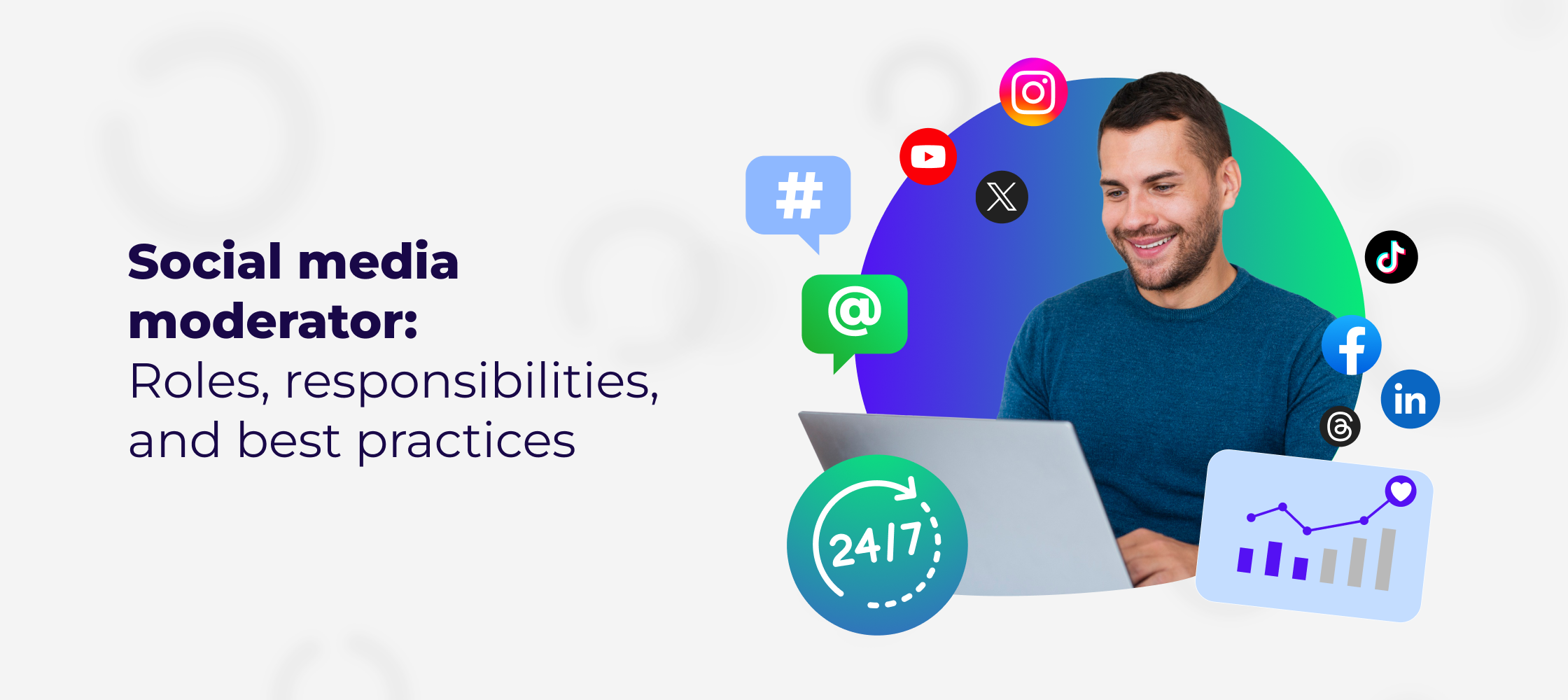
Who is protecting your brand when customer complaints, spam, misinformation, and high-risk comments surface after your team has logged off?
A social media moderator helps your brand manage the comments, messages, reviews, and conversations that shape public perception every day. Brand conversations now happen 24/7 across Instagram, TikTok, Facebook, YouTube, LinkedIn, Reddit, X, Pinterest, review platforms, and private communities.
For CMOs and marketing leaders, moderation is no longer a back-office task. It affects trust, customer experience, brand safety, crisis prevention, and even how public brand conversations may influence visibility across search and AI discovery.
This article breaks down what social media moderators do, why the role matters, and how enterprise teams can scale moderation with the right mix of people, guidelines, workflows, and technology.
What is a social media moderator?
A social media moderator is responsible for reviewing and managing activity on a brand’s social channels. This includes comments, replies, direct messages, tagged posts, reviews, live chat, user-generated content, and conversations happening in online communities.
The role is different from general social media moderation, though the two are closely connected. Social media moderation is the overall process, while the moderator is the person applying your guidelines, reviewing context, making judgment calls, and escalating issues when needed.
A social media moderator typically:
Reviews comments and UGC: Moderators identify posts, comments, images, videos, and replies that need approval, removal, hiding, or escalation.
Removes harmful content: They act on spam, scams, hate speech, harassment, misinformation, impersonation, explicit content, and other high-risk activity.
Escalates sensitive issues: They route legal, PR, safety, compliance, and customer care issues to the right internal teams.
Supports customer care: Moderators help identify complaints, service questions, and urgent needs so customers are not left unanswered.
Enforces community guidelines: They apply your moderation rules consistently so your audience understands what is allowed.
Protects brand voice: They keep engagement aligned with your tone, values, and response standards.
A strong moderator does more than remove comments. They help your brand create safer conversations, spot early risks, and keep your audience experience consistent across every channel.
Social media moderation vs. content moderation vs. community management
These terms are often used interchangeably, but they are not the same. Clarifying the difference helps your team define ownership, hire the right support, and choose the right moderation model.
Function | What it means | Common examples | Why it matters |
Social media moderation | Managing comments, messages, reviews, and conversations across social platforms | Hiding spam, escalating threats, reviewing TikTok comments, and monitoring Reddit threads | Protects brand safety and keeps social spaces healthy |
Content moderation | Reviewing user-generated content against platform, legal, brand, or community rules | Reviewing uploaded images, flagged posts, product reviews, videos, or forum posts | Reduces exposure to harmful, illegal, unsafe, or off-brand content |
Community management | Engaging with your audience to build relationships and participation | Replying to fans, welcoming new members, encouraging discussion, answering common questions | Builds trust, loyalty, and stronger audience relationships |
Social media moderation and content moderation overlap when user-generated content appears on social platforms. A social media content moderator may review comments on Instagram, flag videos on TikTok, monitor live chat on YouTube, or review customer posts in a Facebook group.
Community management is more engagement-focused. It helps your brand build relationships. Moderation protects the space where those relationships happen.
Why social media moderation matters
Social media moderation matters because unmanaged conversations can quickly affect customer trust, campaign performance, and brand reputation. A comment section filled with spam, harassment, unanswered complaints, or misinformation sends a message before your campaign creative ever has a chance to work.
For marketing leaders, moderation connects directly to business outcomes. It protects reputation, improves customer trust, reduces risk, and helps your team respond before small issues become larger problems.
Strong moderation supports:
Brand safety: Harmful comments, scams, impersonation, hate speech, and misinformation can damage customer confidence. Clear moderation keeps unsafe activity from taking over your channels.
Customer trust: People notice whether your brand responds with care. Timely review and response show your audience that someone is listening.
Community health: Healthy communities need clear boundaries. Moderators keep conversations useful, respectful, and aligned with your standards.
Crisis prevention: Spikes in negative comments, coordinated attacks, or repeated complaints can signal a larger issue. Early review gives your team time to act before the issue spreads.
Customer experience: Social channels are now customer care channels. Moderators help route questions, complaints, and urgent needs to the right team.
AI visibility: Public social conversations, reviews, forums, and community discussions can influence how AI systems understand brand sentiment and reputation. Stronger public conversations create clearer signals for AI-powered discovery.
Without moderation, your team risks letting the loudest or most harmful voices define the conversation. Spam can crowd out real customers. Harassment can make communities feel unsafe. Misinformation can spread before internal teams know it exists. Negative comments can escalate when they go unanswered, especially if customers feel ignored.
If your team already has guidance for negative comments on social media, moderation helps make that guidance operational. It gives your team a repeatable way to decide what to hide, what to answer, what to escalate, and what to track.
What this means for brands: Moderation is part of how your brand earns trust in public. It gives your marketing, customer care, legal, PR, and social teams a shared system for protecting your audience and your reputation.
How enterprise brands overcome common moderation challenges
Moderation becomes more complex as your community grows. Higher comment volume, global audiences, paid campaigns, influencer partnerships, live events, and crisis moments all create more opportunities for brand risk to emerge.
Enterprise requires defined ownership, trained moderators, escalation paths, and coverage that can flex when volume spikes.
Protecting brand safety and community trust
Brand safety starts with identifying content that could harm your audience, employees, or reputation. Social media moderators help identify and act on high-risk content, such as:
Hate speech and harassment: Comments that target, intimidate, or exclude people.
Spam and scams: Fake promotions, phishing attempts, bot activity, and suspicious links.
Misinformation: False or misleading claims that could spread quickly.
Threats and unsafe advice: Comments that create safety, legal, compliance, or customer care concerns.
Impersonation: Fake accounts or misleading posts that appear to represent your brand.
The challenge is context. A sarcastic comment, slang phrase, or cultural reference may look harmless to a tool but carry real risk. Automated systems can also flag harmless fan comments when they miss tone, intent, or local language.
Human-in-the-loop moderation gives your team speed without removing judgment. AI can flag patterns and prioritize queues, while trained moderators decide what the content means and what action fits your brand guidelines.
Managing coordinated attacks with rapid response
Coordinated attacks can overwhelm a comment section fast. Trolls, brigading, review bombing, spam waves, and organized harassment can shift the tone of a conversation within minutes.
Always-on moderation gives your team a faster way to:
Identify the spike: Spot unusual volume, repeated language, or coordinated behavior.
Confirm the risk: Separate real customer concern from spam, trolling, or harmful activity.
Document activity: Keep a clear record of what happened, when it happened, and how your team responded.
Escalate quickly: Route high-risk issues to PR, legal, compliance, customer care, or social leadership.
Rapid response does not mean reacting emotionally. It means your team has a clear process for understanding the issue and moving it to the right decision-maker before a comment spike becomes a larger reputation issue.
Moderating confidently during high-profile events
High-profile moments can quickly increase moderation demand. Product launches, executive announcements, influencer campaigns, earnings updates, breaking news, and PR issues all bring more attention to your social channels.
Before volume spikes, moderators need clear direction on:
Approved response language: What they can say, what they should avoid, and when to pause.
Escalation contacts: Who owns PR, legal, compliance, customer care, and executive review.
Risk thresholds: When to hide, remove, respond, escalate, or document a comment.
Channel expectations: How tone and response speed should shift across TikTok, Instagram, LinkedIn, YouTube, Reddit, and other platforms.
A social media crisis plan helps your team move faster because decisions are not being made from scratch under pressure. If an issue escalates, your moderation team should also know how to support the steps needed to recover from a social media crisis.
Scaling human moderation across global communities
Global social media moderation requires language fluency, cultural awareness, and consistent governance. A Facebook moderator in one market may need different context than a TikTok moderator reviewing comments in another region.
Each platform also requires its own moderation lens, because audience behavior, content format, and response expectations shift by channel:
Reddit moderators need to understand subreddit culture, community rules, and discussion expectations.
Discord moderators often manage fast-moving community conversations, private server rules, member behavior, and escalation needs across niche groups.
Instagram moderators often manage brand safety, campaign comments, influencer activity, and visual UGC.
YouTube moderators may need to manage comments, live chat, and long-form video discussions.
LinkedIn moderators often need a more professional tone and stronger sensitivity to executive visibility.
Yelp moderators may help surface service-related feedback and recurring customer care issues.
X content moderators may need to track fast-moving replies during live events or breaking issues.
These differences affect how moderators interpret intent, decide when to engage, and know when a comment should move into a formal escalation path.
Social media moderation best practices
Strong moderation starts with preparation. Your team needs clear guidelines, trained people, smart workflows, and a process for continuous improvement.
These content moderation best practices help teams moderate with more consistency and less confusion:
Create moderation guidelines: Your content moderation guidelines should explain what is allowed, what is removed, what requires review, and what needs escalation. Include examples so moderators can apply the policy in real situations.
Define escalation workflows: Make it clear who owns customer complaints, legal concerns, compliance issues, safety threats, misinformation, and PR risks. Include expected response times and backup contacts.
Moderate consistently: Customers lose trust when rules feel random. Consistency helps your audience understand the standards of your community.
Balance speed with accuracy: Fast moderation matters, but speed without context can create mistakes. Give moderators enough guidance to act quickly without guessing.
Combine AI and human review: AI can help detect volume spikes, repeated language, spam patterns, and sentiment shifts. Human moderators bring empathy, cultural context, and judgment.
Monitor continuously: Social does not pause after business hours. Continuous monitoring helps your team catch issues while they are still manageable.
Review policies regularly: New platform features, cultural shifts, campaign types, and customer expectations can change moderation needs. Review your rules often so they stay useful.
Document decisions: Keep records of escalations, removals, response approvals, and policy exceptions. Documentation protects your team and improves future training.
Connect moderation to reporting: Track themes, sentiment, response volume, escalation categories, and recurring issues. Moderation data can reveal customer pain points your broader business needs to address.
Social media content moderation best practices are most effective when they are practical. A policy document alone will not protect your brand. Your moderators need examples, training, workflows, and direct access to the teams that can resolve issues.
Human moderation vs. AI moderation
AI has become an important part of moderation, especially for brands managing high volumes of content. It can help detect spam, flag potentially harmful language, identify sentiment changes, route comments by urgency, and reduce the manual burden on your team.
AI is especially helpful for:
Volume management: AI can scan large volumes of comments and prioritize those that need review.
Pattern detection: AI can identify repeated phrases, coordinated activity, spam signals, and sudden shifts in sentiment.
Routing support: AI can help direct customer care issues, brand safety concerns, and general engagement into the right workflows.
Speed: AI can surface potential issues faster than a human team reviewing every comment manually.
But AI moderation has limits. It can misread sarcasm, cultural context, slang, humor, sensitive topics, and multilingual nuance. It may also apply rules too broadly or miss emerging risks that do not match known patterns.
Human moderation adds the judgment that AI cannot provide. Moderators understand context, tone, platform norms, customer emotion, and brand voice. They can tell when a complaint needs empathy, when a joke is harmless, when a comment should be escalated, and when a response may create more risk.
The strongest model uses both. AI helps prioritize and organize. Human moderators decide, respond, and escalate with care. For a deeper look at this balance, ICUC’s guide to AI in social media explains how automation can support smarter social operations without removing human oversight.
How to build and scale a moderation team
Scaling moderation starts with defining what your team needs to protect. A small brand may only need business-hour comment review. An enterprise brand may need 24/7 coverage, multilingual moderators, regulated-industry training, customer care routing, crisis escalation, and reporting across multiple markets.
Who owns moderation internally?
Moderation often sits between social, marketing, customer care, legal, compliance, PR, and brand teams. That can create confusion if ownership is not clear.
Your team should define:
Who reviews daily comments and messages
Who approves responses for sensitive issues
Who handles customer care escalations
Who owns legal, compliance, or safety review
Who makes decisions during a crisis
Who reports trends and risks to leadership
Clear ownership helps moderators act faster. It also prevents issues from sitting in a queue because no one knows who should respond.
When do brands need 24/7 moderation?
You may need 24/7 moderation if your audience spans multiple time zones, your industry carries higher risk, your brand receives high comment volume, or your social channels regularly handle customer care issues.
Always-on moderation is especially useful when you manage:
Global communities
Regulated industries
Product launches
Influencer campaigns
High-volume paid social
Live events or livestreams
Customer complaints after hours
Communities with frequent spam or harassment
Brand safety or reputational risk
If customers can contact you at any hour, they can also escalate frustration at any hour. Around-the-clock moderation helps you identify issues before they compound.
In-house vs outsourced moderation
In-house moderation gives your team direct control and deep brand familiarity. It can work well when volume is manageable and coverage needs are limited.
Outsourced moderation helps when your team needs broader coverage, faster scaling, multilingual support, surge capacity, or specialized expertise. It can also reduce burnout among internal teams managing social strategy, publishing, reporting, engagement, customer care, and risk response.
The right model may include both. Your internal team can own strategy, approvals, and brand direction, while a moderation partner can handle always-on coverage, queue management, escalation, reporting, and multilingual support.
Social media moderation tools and services
Moderation tools help your team manage volume, organize workflows, and report on activity. They can flag spam, surface sentiment shifts, route comments, and show where conversations are gaining momentum. But in enterprise moderation, tools are only the starting point.
Technology can identify what needs attention. Human moderators decide what it means.
That distinction matters when your team is reviewing sensitive comments, cultural references, sarcasm, misinformation, customer frustration, or fast-moving campaign activity. A tool may flag a phrase as harmful, but a trained moderator can evaluate context, understand brand nuance, apply the right guideline, and decide whether the issue needs a response, removal, documentation, or escalation.
Common moderation tools include:
Detection tools: These help identify spam, harmful language, repeated phrases, sentiment shifts, suspicious behavior, and high-risk content.
Workflow tools: These help route messages, assign tasks, track approvals, apply labels, and document escalations.
Reporting tools: These help measure comment volume, response times, escalation categories, sentiment trends, and recurring customer issues.
Platform-native tools: Many social platforms offer built-in moderation features for comments, live chats, groups, reviews, and keyword filtering.
Listening and social management tools: Platforms such as Sprinklr, Brandwatch, Hootsuite, Sprout Social, Loomly, and Khoros can help teams monitor conversations, manage workflows, and report on social activity.
For enterprise brands, the real value comes from pairing these tools with experienced moderators who understand your brand voice, audience expectations, cultural context, and escalation rules. Human expertise helps your team avoid over-removing harmless content, missing subtle risk, or responding in a way that feels out of step with the moment.
ICUC works within leading social and listening platforms while trained moderators apply brand guidelines, cultural context, escalation rules, and human judgment across channels. That human-in-the-loop model helps your team move faster without handing sensitive brand decisions entirely to automation.
How moderation supports brand safety, customer care, and AI visibility
Moderation does more than keep harmful content out of your channels. It also gives your team a live view of what customers are asking, where sentiment is shifting, and which issues need attention beyond social. When moderators track patterns across comments, reviews, DMs, and community threads, social becomes a source of customer intelligence.
Social moderation supports:
Customer experience signals: Moderators help identify unanswered questions, service issues, and moments where a customer needs support.
Voice of the Customer insights: Recurring comments reveal product issues, campaign reactions, pricing concerns, service gaps, and audience sentiment.
Early crisis indicators: Sudden changes in volume or tone can signal a developing risk before it reaches leadership or the media.
Reputation patterns: Moderation helps your brand respond consistently, empathetically, and with accountability across public channels.
AI search visibility: AI tools can learn from public content across social platforms, forums, reviews, and other digital sources. If those conversations consistently reveal unresolved issues, misinformation, or negative sentiment, they can shape how your brand is perceived in AI-powered discovery.
Review channels are also part of this ecosystem. A thoughtful approach to how to respond to negative reviews can help your team apply the same care and consistency across public feedback, social comments, and customer care interactions.
Scale social media moderation with ICUC
ICUC helps enterprise brands protect communities, manage high-volume conversations, and respond with confidence across social channels. Our teams provide always-on moderation, global coverage, multilingual support, crisis escalation, human-in-the-loop review, governance playbooks, and white-glove support that works as an extension of your internal team.
When your brand needs more than basic comment review, ICUC gives you the people, process, and judgment to moderate at scale. We help you protect reputation, improve response consistency, support customer care, and surface the social signals your leadership team needs to see.
Explore ICUC’s social media moderation services to see how always-on moderation can support your brand. And book a meeting with our team thttps://www.icuc.social/our-services/social-media-moderationo see what stronger moderation could look like across your channels.
FAQ: Social media moderator
Do brands need 24/7 social media moderation?
Brands need 24/7 social media moderation when their audience is active outside business hours, their brand operates globally, or their social channels carry customer care, compliance, or reputation risk. Around-the-clock coverage helps your team catch spam, complaints, harmful content, and emerging issues before they grow.
What is the difference between a social media moderator and a community manager?
A social media moderator focuses on safety, guidelines, risk review, and content decisions. A community manager focuses on engagement, relationship-building, and audience participation. In many teams, the roles work closely together because healthy communities need both protection and connection.
How do large brands moderate comments at scale?
Large brands moderate comments at scale by combining clear guidelines, trained moderators, escalation workflows, moderation tools, reporting, and AI-assisted triage. The strongest programs also include human review for nuance, brand voice, cultural context, and sensitive issues.
How many moderators does a brand need?
The number of moderators depends on comment volume, number of channels, languages, risk level, response expectations, and coverage hours. A brand with one active channel may need limited support. A global enterprise may need an always-on team across platforms, regions, and time zones.
Can AI replace social media moderators?
AI cannot fully replace social media moderators. It can help detect patterns, prioritize queues, and flag potential risks, but human moderators are still needed for judgment, empathy, cultural nuance, and brand-safe decisions. The best approach uses AI to support people, not remove them.
Detection tools: These help identify spam, harmful language, repeated phrases, sentiment shifts, suspicious behavior, and high-risk content.
Workflow tools: These help route messages, assign tasks, track approvals, apply labels, and document escalations.
Reporting tools: These help measure comment volume, response times, escalation categories, sentiment trends, and recurring customer issues.
Platform-native tools: Many social platforms offer built-in moderation features for comments, live chats, groups, reviews, and keyword filtering.
Listening and social management tools: Platforms such as Sprinklr, Brandwatch, Hootsuite, Sprout Social, Loomly, and Khoros can help teams monitor conversations, manage workflows, and report on social activity.
Tools can help organize the work, but they are only part of the moderation model. ICUC works within leading social and listening platforms while trained moderators apply brand guidelines, cultural context, escalation rules, and human judgment across channels.
About the Author

Nicole van Zanten
As Chief Growth Officer at ICUC, Nicole leads global growth across marketing, client success, and business development. With over 15 years of leadership in social media, content strategy, and digital transformation, she brings a unique mix of creative vision and operational rigor to building high-performance teams and sustainable revenue growth.