

Social Media Moderation: A Complete Guide

Why is social media moderation important? Consider when a major brand’s stock price fell 10% after a negative social media post.
Social media moderation creates healthy, safe online communities by enforcing clear guidelines and removing user-generated content (UGC) that could lead to legal, financial, or reputational challenges.
As brands grow their online presence, whether by creating new channels, collaborations, or accounts, the need for moderation grows with them. For enterprise brands, 24/7 moderation coverage and real-time risk escalations provide the care and transparency their customers expect.
This article explains what social media moderation is, best practices, including how to use AI, and when to seek outside moderation support.
What is social media moderation?
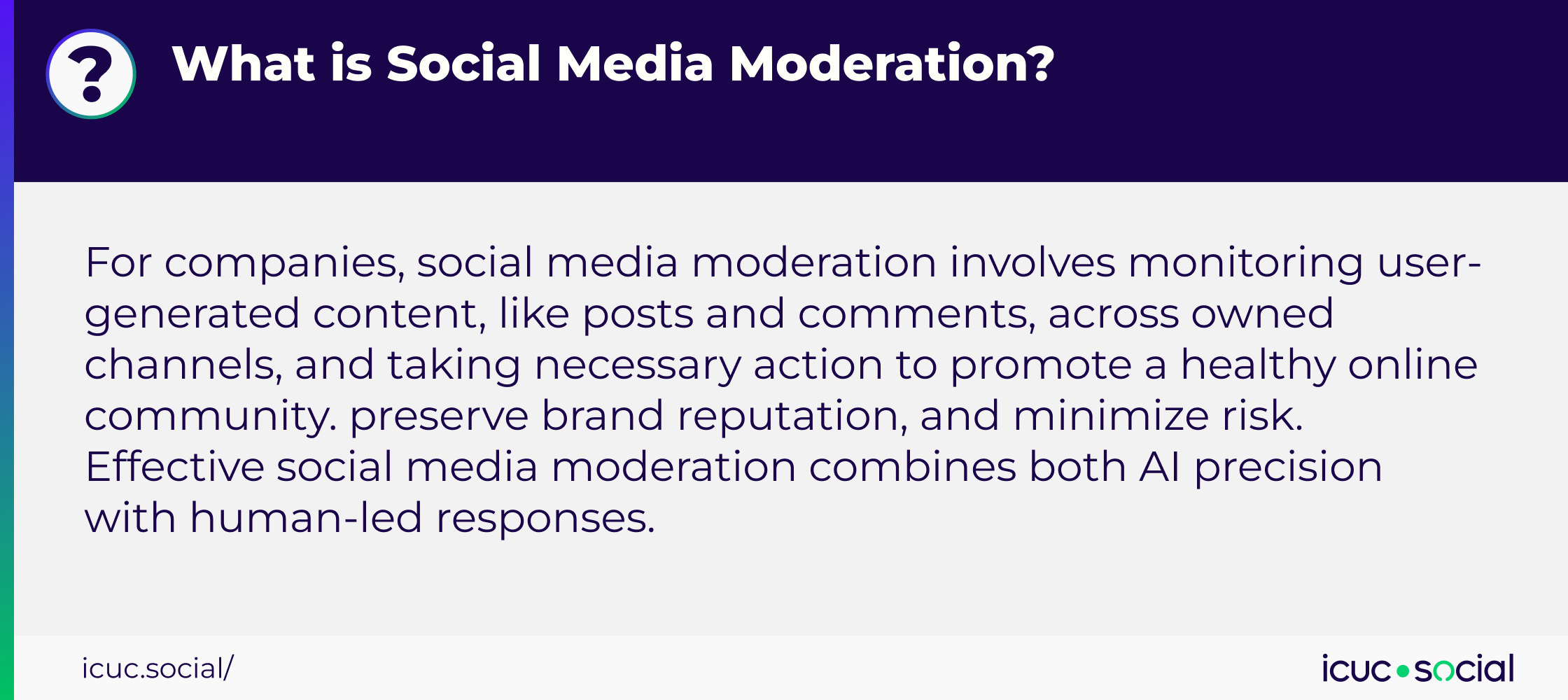
Social media moderationinvolves active oversight of a brand’s owned channels to maintain a safe and healthy online community. Moderation can include posts, comments, replies, direct messages, and even reviews, forums, and other community spaces.
What is the difference between social media moderation and social media monitoring? Social monitoring helps brands identify mentions across all social media platforms, while moderation is controlling the communities owned and operated by the brand. For example, a brand may detect a mention on a popular influencer’s account and may choose to respond to comments on that post. That is social monitoring.
Social media moderation involves actively scanning, engaging with, and deleting all comments on a brand post, Discord channel, Reddit thread, etc., and any channel owned by your brand.
Social media moderators leverage social monitoring to engage with content, resolve issues in real time, and directly impact the customer experience.
Let’s take a closer look at the benefits of social media moderation.
The importance of social media moderation
Social media moderation creates a safe space for brands to engage with customers and build stronger, long-term relationships based on trust.
“Trusting our social media moderation to ICUC has been a wonderful time-saver for us. We get the benefit of authentic customer insights without investing time and energy into a new department. ICUC has been a great partner to us.”
Safer, more welcoming digital spaces
Audiences can tell when a brand has invested in social media moderation. Moderated spaces come with more structure, setting clear expectations for audience participation.
These guardrails encourage authentic engagement and prevent harmful behavior, such as harassment or abuse, that could create a negative association with the brand.
Stronger customer relationships
Moderation—specifically from human moderators—preserves empathy in what are otherwise highly emotional moments. Responses feel much more authentic when they’re guided by people, not by scripts.
Well-moderated spaces create an arena for meaningful, not defensive, dialogue. It allows the online space to serve the purpose it’s intended for: building genuine, two-way relationships.
Elevated community experience
Consistent moderation improves the community experience, which in turn improves the perceived quality of the brand. In any digital environment, there are always going to be conversations, whether they’re off-topic, spammy, or malicious, that add noise.
Moderation ensures that valuable conversations and peer-to-peer engagement have room to flourish and helps follow community management best practices.
Reinforced trust and loyalty
Companies that put time and effort into creating a safe online environment for their audience show they care about their audience’s well-being. This effort, combined with consistent responses, demonstrates accountability, which helps build trust.
Next, we’ll discuss the core actions for comprehensive social media moderation.
Key responsibilities with social media moderation
Social media moderation involves flagging potentially harmful content, deciding action, responding, tracking sentiment, and escalating possible crises, all while complying with applicable regulations.
Content filtering and protection
Content filtering and protection involves the identification and removal of any content that’s harmful, abusive, or violates an internal policy. This includes controlling any scam, spam, or bot content.
Many content platforms have built-in censors that filter out this kind of content, but sometimes they’re insufficient. Therefore, human moderators are needed for full coverage.
Thoughtful customer responses
While AI moderation has improved significantly, emotionally charged situations often call for thoughtful, sensitive responses that only humans can provide.
The best responses, whether to a social post or an online review, should align with your brand voice and focus on complete de-escalation.
Sentiment monitoring
Sentiment monitoring goes beyond reading individual comments. It involves the ongoing evaluation of the moods and views expressed in online content.
When aggregated, these patterns provide brands with a clear overview of overall customer sentiment, informing marketing strategy.
Crisis and escalation management
Proper social media moderation leads to quick escalation to stop emerging issues in their tracks.
Also known as social media crisis management, escalation management works best when there are clear escalation paths across teams and agreed-upon messaging that can be coordinated in high-risk moments. Ideally, teams should keep documentation for post-incident review.
Compliance support
Regulated industries are under even more scrutiny than others. This means they need to moderate with an even greater degree of scrutiny, with ample documentation and audit-readiness. They should be well-positioned to handle sensitive topics with the kind of finesse customers expect.
Given its breadth, many teams prefer to treat social media moderation not as a one-off consideration but as a long-term, holistic strategy.

Insights that inform strategy
Insights are a main reason why social media moderation is worth the investment. When done well, moderation can help brands understand what their audience is thinking, feeling, and desiring.
These valuable insights can help shape marketing strategies and can even impact important decisions around product or feature launches. When embraced, brands benefit from the rare opportunity for unfiltered feedback that social media channels provide.
Human and AI moderation working together
AI-powered automation is powerful for its ability to work through a high volume of content with speed. It is especially useful for pattern recognition and real-time flagging of potential issues.
However, humans bring context, empathy, and cultural understanding. These have never been so essential to a brand’s online strategy.
This is especially useful for brands that manage compliance across multiple social platforms, which can be complex in some industries.
“If we just had an AI tool handling our social media moderation, we would feel okay, but ICUC’s human involvement allows us to feel completely protected. We know their technology is auditing our content at all times, and their human teams are there to respond with sensitivity any time it’s required.”
Common moderation challenges by platform
Regardless of the platform, there are some universal challenges like high volume surges, burnout, abuse, and trolls. But each platform carries its own unique moderation challenges:
Reddit: Reddit tends to carry its own community-driven norms. This often includes a relatively high skepticism towards brands and more nuanced moderation expectations.
Meta: Meta sees a high comment volume, which can be difficult to manage. There is also a high degree of spam and scam activity.
LinkedIn: As a predominantly B2B network, LinkedIn carries a low tolerance for misinformation, spam, or misleading content.
Twitter (X): Conversations on Twitter (X) tend to be very fast-moving, which means misinformation can spread quickly (as can escalations).
TikTok: TikTok is known for its virality, so brands should be prepared to keep up with the trend-driven surges and comment pile-ons that accompany it.
With these unique challenges in mind, brands can develop a best-practice plan for social media moderation.
Best practices for social media moderation
While the following won’t be a clear “copy and paste” strategy for all brands, these create a foundation for your social media moderation strategy.
A clear, purpose-driven framework
Clearly document your social media guidelines, including tone, threshold for risk, and escalation paths. Not only does this help maintain consistency across platforms, but it also helps unite your team and improve handoff procedures.
Always on coverage and responsiveness
Because social media doesn’t sleep, continuously monitor your channels, 24/7. For human coverage around the clock, consider partnering with a third-party vendor.
Human insight enhanced by technology
The best moderation strategies often involve both human insight and technology enhancements. AI in social media is useful for routing, tagging, and prioritizing tasks, but humans are irreplaceable when it comes to response judgment.
Scalable support across platforms and languages
If you want to expand your presence to new markets or countries, your team must be ready for the increase in engagement. In these cases, multilingual moderation becomes necessary to earn trust across the globe.
Risk awareness and proactive protection
Effective moderation strategies proactively catch patterns. This requires great pattern recognition across conversations, a thorough escalation and mitigation plan, and proactive leadership.
Insight-driven reporting and continuous improvement
Keep stakeholders informed through regular reporting on themes and risks across social media. This helps to create cross-collaborative feedback loops for policy refinement.
Internal policies should be reviewed regularly and revisited as brand goals change.
A unified partnership with internal teams
Though social media moderation can be handled in-house, teams should seek third-party support as soon as they start to feel overwhelmed. This reduces the risk of burnout and ensures nothing gets missed.
When to seek outside moderation support
Some signs that it’s time to seek outside moderation support for your social media strategy include:
Global expansion: If your brand is expanding or launching in a new market, especially if the new market speaks a different language.
Teams seem overwhelmed: When your social media accounts are receiving more messages than your team can keep up with in a standard workday.
Seasonal surges: If you’re approaching the time of the year when you see a seasonal shift, or if you’re planning a large campaign.
Increased brand risk: If your brand has been in the news recently, either positively or negatively.
If any of the above resonates with you, it might be time to start thinking about how to select the right partner.
How to choose the right moderation partner
When looking for a moderation partner, here’s what to look for:
Proven reliability: Ask within your network or look online for reviews. You want a partner that has proven their reliability and accuracy.
Human-led workflows: The most effective social media moderation leverages AI to detect, and humans to respond.
24/7 global coverage: If you plan to scale your business, look for a provider that can offer you multilingual, 24/7 coverage.
Experience in high-risk environments: If you work in a regulated industry, select a partner that is familiar with applicable laws and regulations.
When searching for a content moderation partner, many brands gravitate towards ICUC. Take the Great Courses, for example, which used ICUC to save up to 70% of traditional staffing costs, while still accommodating a 210% increase in engagement.
Protect your brand with ICUC social media moderation
Today, audiences turn to social media to interact with brands. That’s why social media content moderation is essential to earning trust, cultivating loyalty, and protecting your brand’s reputation.
As engagement volumes grow, even small gaps in judgment can create risk. Social media moderation gives brand managers the peace of mind that their online spaces are safe, welcoming, and well-aligned with the company’s mission.
ICUC offers strategic moderation support with 24/7, multilingual coverage that empowers brands to scale with confidence.
Powered by AI detection and social monitoring tools, ICUC social media moderators work to review, respond, and escalate content where needed. Every interaction begins with empathy, and no risk goes unattended. To see how ICUC can support your brand, book a strategy meeting today.
FAQ: social media moderation
What makes social media moderation different from community management?
Social media moderation proactively protects brands from harmful or risky content online. Community management centers around engagement and growth and not necessarily risk management.
How do brands know when their moderation approach isn’t working?
Brands might find themselves facing a lot of warning signs, like rising toxicity, delayed responses, increased customer frustration, and even bad publicity. If internal teams feel overwhelmed, this is also a sign that something isn’t working.
What types of content require the most careful moderation?
Highly-regulated industries like pharmaceuticals, insurance, or finance can often be held to the highest standards. But any content involving controversial or sensitive topics can also require heightened care.
How can human and AI moderation work together effectively?
Yes, and it’s actually recommended that they do. AI can help businesses scale by flagging risks, while human moderators provide the empathy audiences find refreshing.
What should a brand prioritize when scaling moderation across multiple platforms?
Brands should ensure their moderation is both uninterrupted and consistent. Many brands find it helpful to set out a series of internal documents or SLAs that outline how team members should interact on social media channels.
About the Author

Nicole van Zanten
As Chief Growth Officer at ICUC, Nicole leads global growth across marketing, client success, and business development. With over 15 years of leadership in social media, content strategy, and digital transformation, she brings a unique mix of creative vision and operational rigor to building high-performance teams and sustainable revenue growth.