
Holiday shopping in 2026: Research on value, timing, and discovery
What is the research about?
ICUC’s 2026 holiday shopping research shows consumers are shopping earlier, weighing affordability against emotional value, and discovering gifts across social, creator, commerce, and AI channels. For marketers, winning holiday consideration increasingly depends on understanding where shoppers see value and where their decisions are being shaped.

Holiday shopping is becoming more deliberate. As consumers navigate higher everyday costs and economic uncertainty, they are starting earlier, comparing more carefully, stacking savings, and thinking harder about what actually deserves a place in the holiday budget.
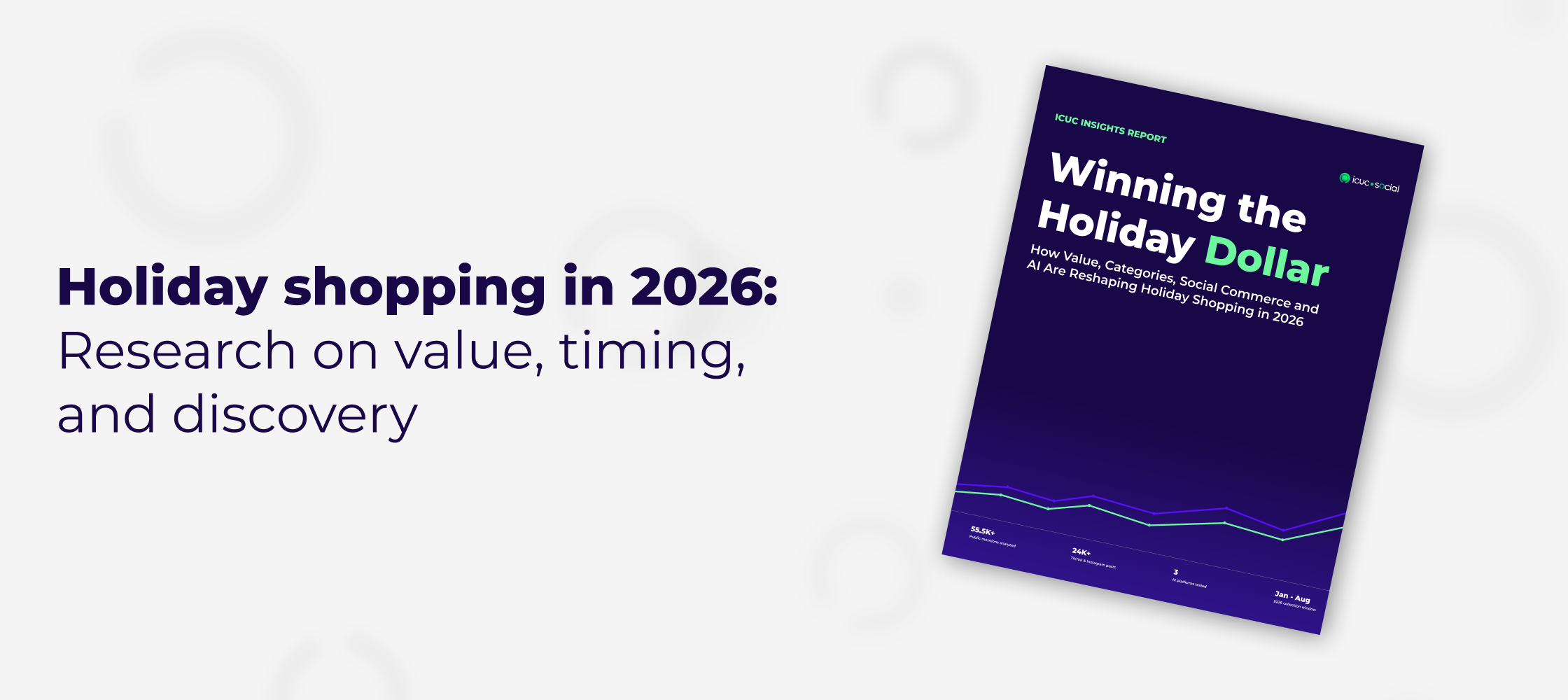
ICUC analyzed more than 55,500 public social mentions, another 24,000+ TikTok and Instagram mentions, and holiday gift recommendations across ChatGPT, Gemini, and Perplexity from January through August 2026.
The conversations reveal an important shift: consumers still want to celebrate, but they are looking for more control over how, when, and where they spend. For marketers, understanding what shoppers are saying can help explain what they are likely to do next.
Want the full picture? Download ICUC’s 2026 Holiday Shopping Behavior White Paper for the complete research, category data, social listening insights, and AI discovery findings.
H2: 2026 holiday shopping trends at a glance
ICUC’s research points to four shifts shaping holiday behavior in 2026. Together, they show a shopper who is planning earlier, stretching value further, prioritizing purchases that feel worthwhile, and discovering products across a wider mix of channels.
Holiday behavior ICUC observed | Signal behind it | Implication for marketers |
Earlier planning | Holiday conversation rises in summer | Build awareness before promotional competition peaks |
Savings stacking | Coupons, cashback, rewards, credits, and clearance are combined | Show the complete value proposition, not one discount |
Experience-led gifting | Experiences led gift-driver conversation at 31% | Connect products and offers to memories, usefulness, or emotional payoff |
AI-assisted discovery | 10% of holiday chatter intersected with AI topics | Monitor how products and brands appear across AI discovery environments |
These signals become more useful when you look at what is driving each behavior and how those patterns are changing the holiday journey.
Holiday shopping is starting earlier as consumers seek more control
For some shoppers, waiting until November now feels like an unnecessary financial risk. ICUC’s data shows holiday conversation building throughout the summer: in 2025, mentions rose from 8,725 in June to 13,157 in July and 20,248 in August. Early activity is even stronger in 2026.
11.6% increase in holiday-shopping mentions during June and July 2026 compared with the same period in 2025.
The conversations help explain why. Consumers describe buying gifts throughout the year, using sales to spread out spending, keeping gift inventories, and setting personal deadlines well before December. Some specifically frame early shopping as a way to avoid debt, delivery delays, out-of-stock products, and last-minute stress.
Public research reflects the same behavior. A Basis study found that 68% of consumers shop early to avoid delays, while 57% shop throughout the year for deals. Together, the findings suggest that holiday consideration is becoming less tied to the traditional November–December window.
For marketers, the holiday season increasingly begins when consumers start planning, not when brands start running Black Friday creative.
Affordability matters, but shoppers are redefining what “value” means
Economic uncertainty is clearly shaping holiday conversations, but price alone does not explain purchasing behavior.
ICUC found consumers discussing everything from rising grocery and decoration costs to shrinking disposable income and concerns about post-holiday debt. In response, shoppers are spreading purchases across several months, using cashback and loyalty rewards, buying secondhand, making gifts themselves, and narrowing recipient lists.
Their shopping behavior also shows that savings rarely come from one discount. Consumers are combining clearance pricing, coupons, cashback, rewards, app credits, and gift cards to reduce what they ultimately pay.
For marketers, the shift is toward communicating the full value equation: price, savings, usefulness, convenience, and emotional relevance all influence whether a purchase feels worthwhile.
Holiday budgets are splitting between affordability and experiences
ICUC’s research shows that economic pressure is not affecting every holiday shopper in the same way. While some consumers are pulling back, others are protecting spend on the purchases and experiences they consider most meaningful.
Experiences accounted for 31% of gift-driver conversations, narrowly ahead of affordability at 28%.
Other priorities were more evenly distributed: usefulness and meaningful gifting each represented roughly 15%, while flexible options such as gift cards accounted for about 11%.
The contrast points to a K-shaped holiday economy. Budget-conscious shoppers are reducing gift obligations, seeking lower-cost alternatives, and prioritizing practical purchases. At the same time, other consumers continue to spend on experiences, children, premium items, and gifts that create lasting memories.
For marketers, this makes audience context especially important. The same holiday message will not resonate equally with a shopper focused on stretching a limited budget and one willing to spend more on an experience or premium gift. Segmenting messaging around different spending priorities can help brands show the right kind of value to each audience.
Social and AI are shaping what enters the consideration set
Where consumers discover holiday ideas is changing too. ICUC observed creator-led Christmas content appearing as early as July, with #ChristmasInJuly present in 8% of analyzed content. Holiday-focused creator accounts also became more active in July and August, helping normalize earlier planning and product discovery.
Social commerce is bringing discovery and purchase closer together. TikTok Shop, Instagram shopping experiences, and YouTube Shopping allow consumers to act on seasonal discoveries without leaving the environments where those ideas first surfaced.
That discovery journey is expanding again as AI becomes another source of gift and product recommendations.
ICUC found that 10% of holiday-related Brandwatch conversation intersected with AI topics, while testing across ChatGPT, Gemini, and Perplexity showed little consistency in which brands each platform recommended.
Adobe's holiday research supports the broader shift: traffic from generative AI tools to U.S. retail sites increased sharply year over year, even though it still represents a relatively small share of total retail traffic.
For marketers, the bigger challenge is understanding how these discovery environments work together. Creators can spark interest, social commerce can reduce friction between discovery and purchase, and AI can introduce entirely different brands or products into consideration.
Stay ahead of changing holiday behavior with ICUC
Holiday plans may be set months in advance, but shopper behavior can shift quickly throughout the season. New products gain momentum, creator conversations evolve, promotions change what feels valuable, and AI can introduce unexpected brands into consideration. That means holiday strategies need room to adapt as new signals emerge, especially when internal teams are already managing higher seasonal conversation volumes.
ICUC helps brands discover those signals, understand what they mean, and prioritize where to act. As the season evolves, marketing and social teams can use that intelligence to:
Adjust messaging around emerging priorities: Weekly Product Trend Tracking helps identify which products, categories, and gifting trends are gaining momentum, giving teams insight into where to shift content, promotions, and campaign emphasis.
Strengthen visibility across AI discovery: AI Visibility Reporting shows how brands and products appear across ChatGPT, Gemini, Perplexity, and other AI environments so teams can identify gaps and changing competitive visibility.
Respond to what shoppers are actively seeking: Social Search Reporting surfaces the questions, searches, and needs emerging across social platforms, helping brands refine content and messaging around real-time consumer interest.
Scale engagement as conversation increases: ICUC provides flexible social care and community coverage so brands can maintain timely, consistent support across channels without overwhelming internal teams during peak holiday periods.
The strongest holiday strategies are not built once and left unchanged. ICUC gives your team the intelligence and scalable support to prioritize emerging opportunities, adjust where needed, and stay responsive as consumer behavior changes through the season.
Book a meeting to build a more responsive holiday strategy with ICUC.
FAQ: Holiday shopping in 2026
How can brands use holiday social intelligence beyond campaign planning?
Holiday social intelligence can inform product positioning, creator partnerships, promotional timing, customer care, merchandising, and emerging-trend detection. Tracking conversations over time can also help teams distinguish short-lived seasonal buzz from behaviors that may influence broader customer strategy.
How can brands tell whether a holiday trend is worth acting on?
Brands should look beyond a single viral post or sudden spike in mentions. Compare changes in conversation volume with social search behavior, creator activity, sentiment, product interest, and purchase-related signals to determine whether momentum is sustained enough to influence strategy.
How can social listening improve holiday marketing decisions?
Social listening can help teams identify changes in gifting priorities, emerging product interest, affordability concerns, seasonal conversations, and purchase triggers while those shifts are still developing. ICUC’s research used more than 55,500 public mentions to connect consumer conversations with broader holiday-shopping behavior.
Why is real-time holiday research more useful than relying on last year's trends?
Previous-year performance can provide a useful baseline, but it cannot capture new products, shifting consumer priorities, emerging creator conversations, or changes in AI recommendations. Current social and search signals help teams identify what is changing during the season and decide whether existing plans need to adapt.
About the Author

Nicole van Zanten
As Chief Growth Officer at ICUC, Nicole leads global growth across marketing, client success, and business development. With over 15 years of leadership in social media, content strategy, and digital transformation, she brings a unique mix of creative vision and operational rigor to building high-performance teams and sustainable revenue growth.