


Social Media Strategy Template: What to Include and How to Use It
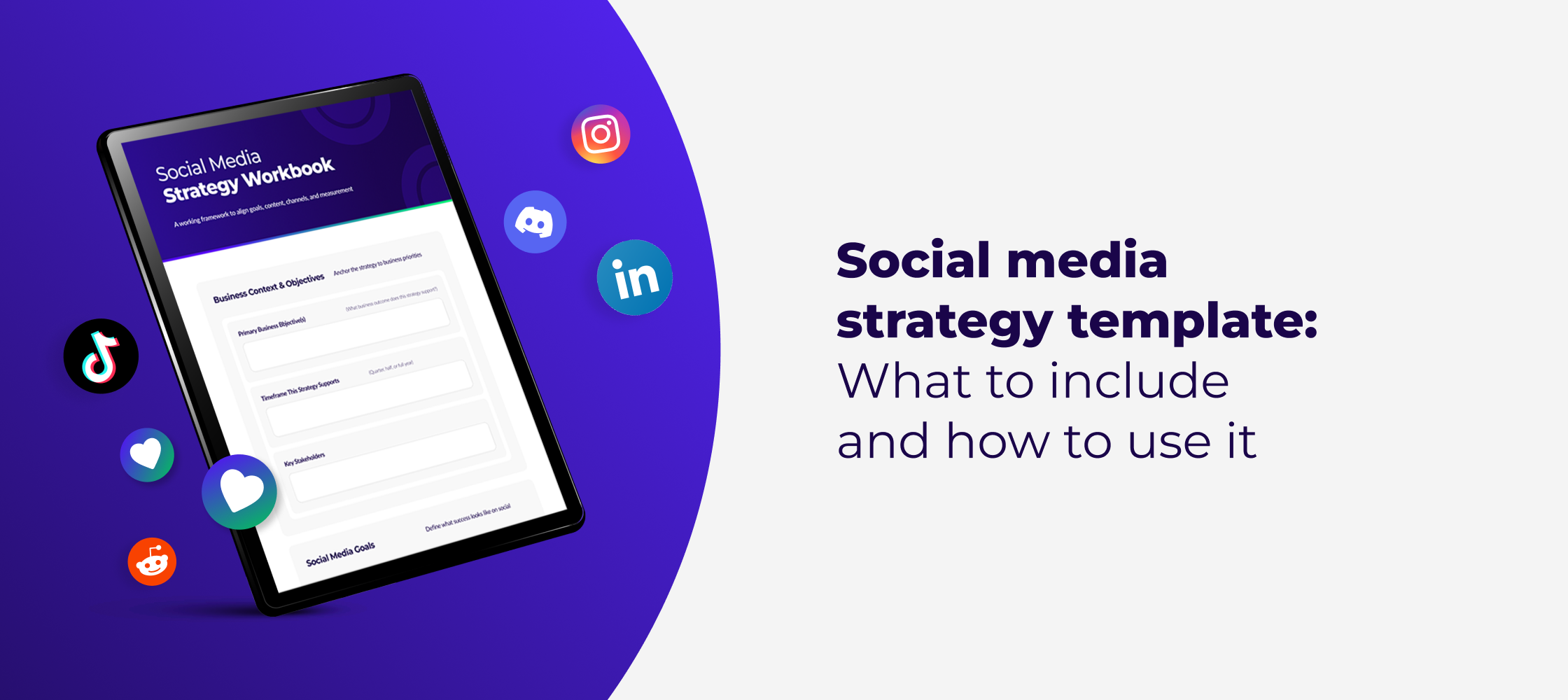
When leadership requests a documented strategy, social teams have two goals: 1) capture the plan in a way that meets governance expectations, and 2) ensure everyone is working from the same set of decisions.
That’s where many templates fall short. Most look polished, but they break down when global brands need to align across markets, channels, and internal stakeholders.
ICUC’s social media strategy template is built for teams managing complexity. It helps document what matters most for consistency, insights, and governance, without turning strategy into busywork.
This template is an operational companion, not a replacement. For the step-by-step process, visit our guide to create a social media strategy, then download the template below to document these decisions.
In this article, we’ll cover what a social media strategy template should include, how to use it day to day, and how to adapt it for multi-team organizations.

Why having a social media strategy template is important
Social teams face pressure to “document the strategy,” but the real challenge is often operational: priorities shift, different regions interpret direction differently, and teams end up posting inconsistent messages, uneven response standards, and unclear escalation paths.
As the number of stakeholders grows, so does the risk of governance gaps, especially across time zones and languages.
A social media strategy template turns your strategic direction into a shared reference that teams can use day to day, and documentation becomes more than words on a page.
It captures decisions that make a strategy executable, such as what the brand will say (and not say), who owns what, how approvals work, what gets escalated, and how performance is measured.
With those standards in one place, teams can work with more consistency and accountability across markets. As complexity increases, a clear, centralized framework becomes an operational requirement.
Next, we’ll break down what a social media strategy template should include.
What a social media strategy template should include
A strong template should capture the essential elements of a strategy in a way that team members can actually use as a part of their day-to-day taskload.
Business goals and success metrics
A social media strategy template should include business objectives. Ideally, there should be a direct link between social activities and broader organizational goals.
For example, instead of aiming for vanity metrics like 100,000 monthly Facebook impressions, the goal could be to improve customer care efficiency or meet response-time SLAs, such as 24 hours or 3 hours for DMs. It should also be mentioned how success will be measured and reported over time.
Audience and voice of the customer insights
Audience and voice-of-the-customer (VoC) insights are the inputs that keep a strategy grounded in how people actually talk about your brand and category.
In a social media strategy template, this step should capture insights from social listening, community interactions, and customer care conversations. This can include recurring questions, sentiment drivers, common objections, emerging topics, and risk signals that require escalation.
To keep this useful for leaders and day-to-day teams, document the data source, date range, and review cadence (e.g., monthly or quarterly), with links to the reporting or listening dashboards.
A brief “what changed since last update” note also helps teams refine messaging and engagement standards as audience expectations shift.
Content pillars and messaging frameworks
Content pillars define the few themes a brand consistently commits to, while messaging frameworks clarify how those themes should sound across audiences and scenarios.
For global brands, pillars often map to needs like product education, customer proof, corporate responsibility, and industry expertise.
A messaging framework then sets guardrails (approved claims, required disclosures, terminology, and do-not-say topics) so teams can create local content that still reflects the same brand decisions.
Channel and market prioritization
Channel and market prioritization clarifies where to focus effort and how execution should vary by region.
The strategy should document which channels are global “always-on” priorities, which are market-specific, and what success looks like for each. It should also set guardrails for localization:
What can be adapted (language, examples, cultural moments, publishing cadence)
What must remain consistent (positioning, brand voice, disclosures, and escalation requirements)
This supports distributed execution without fragmenting the strategy.
Community, reputation, and crisis guidelines
This section connects strategy to the realities of day-to-day social operations by:
Defining moderation and engagement standards: response expectations, tone guidelines, rules for sensitive topics, and when to move a conversation to a private channel.
Outlining reputation and crisis procedures, including what qualifies as a risk event, how issues are categorized, who approves responses, and how escalations work across time zones.
Clear workflows help teams respond quickly while staying within governance.
Measurement and optimization plan
A social media strategy template is most useful when it includes a repeatable process for reviewing performance and updating based on what teams are seeing in the market.
Instead of focusing on outcomes and KPIs here, document how reporting happens: which dashboards or reporting tools teams use, how often results are reviewed, and where insights are stored so they can be referenced across regions.
From there, outline an optimization routine your team can follow. Define how often you refresh content themes, adjust publishing guidelines, update moderation or escalation rules, and incorporate VoC insights from social listening and customer care.
This keeps the template current and ensures improvements are based on documented learnings rather than individual preferences.
Once you have the reporting and optimization workflow in place, you can apply the best practices that help teams maintain it over time.
Social media strategy template best practices
A template only helps if teams treat it as an active operating document, not a one-time deliverable. These practices keep your strategy centralized while still supporting local execution as priorities, platforms, and audience expectations evolve.
Centralize the template as a single source of truth, then allow teams to execute flexibly within approved guardrails.
Update the document on a set cadence and after major shifts (product, policy, platform changes, or emerging risks).
Revisit decisions using VoC insights and performance data to refine what works and retire what doesn’t.
Align content, community management, reputation considerations, and crisis response planning so teams operate from the same playbook.
Assign a clear owner to maintain the template, manage inputs, and enforce version control.
Now that you’re in alignment with best practices, here are some mistakes to avoid.
Common mistakes brands make with social media strategy templates
A template is only useful if teams treat it as an operational reference and keep it up to date. Here are three issues that can limit adoption and create misalignment:
Treating the template like a checklist. A strategy template should document shared decisions and guardrails. Day-to-day checklists, trackers, and guidelines are better suited for task execution.
Ignoring the voice of the customer and real-world feedback. If social listening, customer care interactions, and community inputs consistently surface gaps, revisit and update your strategy.
Letting the template go stale. Treat it as a living document by reviewing it on a set cadence and updating it when governance, escalation paths, ownership, platform features, or risk considerations change.
Next, we’ll look at what teams gain when a social media strategy template stays current and is used consistently across the organization.
How a social media strategy template supports scale and consistency
Global brands operating across multiple markets need a centralized strategy that still allows teams to execute locally.
A social media strategy template keeps goals, messaging direction, and operational processes documented in one place, allowing your teams to work from the same decisions.
A template should support governance without slowing teams down. When guardrails are clear, teams can move quickly while maintaining consistent content and engagement across regions, languages, and stakeholders.
When the template is updated with VoC insights and performance trends, it becomes easier to refine messaging and adjust priorities as new information emerges. This feedback loop supports more consistent scaling of social content across markets without unnecessary rigidity.
If you’re looking to strengthen governance and maintain consistency as your social presence grows, the next section covers how ICUC can support that work.
How ICUC helps brands build and operationalize social media strategy
A documented social media strategy is only effective when it grows with you. Consolidating all information on community engagement, reputation management, and crisis response into a single place enables global brands to scale.
A well-designed social media strategy template helps teams turn documented strategy into day-to-day execution.
ICUC’s social media strategy template provides a practical framework for applying shared decisions across markets, so your teams can make consistent choices that impact brand reputation.
Instead of living in a deck or document, the strategy becomes an active system that evolves with audience behavior and business priorities.
If your organization is ready to bring structure and consistency to global social operations, the next step is implementing the framework.
Download the social media strategy template and pair it with ICUC’s social media strategy services to build a scalable, insight-driven approach to social media management. Then book a meeting with ICUC to see how we can support your online reputation management efforts.
About the Author

Nicole van Zanten
As Chief Growth Officer at ICUC, Nicole leads global growth across marketing, client success, and business development. With over 15 years of leadership in social media, content strategy, and digital transformation, she brings a unique mix of creative vision and operational rigor to building high-performance teams and sustainable revenue growth.