
Pharma social media marketing: Strategy, compliance, and safety
Key takeaways

ICUC’s 2025 social intelligence analysis identified 18.6 million pharma mentions, with 80.7% carrying negative sentiment, revealing a striking gap between pharmaceutical innovation and public perception.
That tension is reshaping pharma social media marketing. Patients, caregivers, HCPs, and advocates are already talking about diagnoses, treatments, side effects, access, affordability, and their experiences with healthcare. KFF found that 55% of U.S. adults use social media for health information and advice at least occasionally, yet fewer than half of users across major platforms consider most or some of the health information they see trustworthy.
Managing social responsibly requires more than publishing MLR-approved content. Your social operation needs to track relevant conversations, recognize potential safety information, engage appropriately, and document what happens across channels and markets.
The regulatory side of that equation also changed in 2026. FDA’s final E2D(R1) guidance provides clearer expectations for newer post-approval data sources, including digital platforms and planned social listening.
This article explains what changed and how to build a pharma social media strategy that connects audience intelligence, pharmacovigilance, trust, compliance, safe execution, and meaningful measurement.
What is pharma social media marketing?
Pharma social media marketing is the use of social channels to educate and engage patients, caregivers, healthcare professionals, and other stakeholders while gathering insights and managing activity within pharmaceutical regulatory requirements.
A modern pharmaceutical social media marketing program may include:
Patient and caregiver education: Share accessible disease-state, treatment, access, and support information.
HCP engagement: Deliver research, clinical updates, conference content, and educational resources.
Social listening: Understand needs, sentiment, misinformation, emerging narratives, and potential safety signals.
Community management and social customer care: Respond to questions within approved parameters.
Reputation management: Track themes affecting trust and brand perception.
Paid and organic content: Reach audiences while applying appropriate claims, disclosures, and fair balance.
Pharmacovigilance workflows: Recognize and escalate potentially reportable information.
These activities often overlap. A post intended to educate patients may generate questions requiring community responses, medical escalation, misinformation management, or safety review.
That makes pharmaceutical social media different from conventional social marketing. Content, listening, and engagement workflows can all intersect with privacy, safety, regulatory, and documentation obligations. Understanding those conversations is the first step toward deciding how your brand should participate.
Why pharma’s social media strategy needs to evolve
Pharmaceutical innovation continues to move forward, yet public perception tells a more complicated story. Themes including cost, access, ethics, and brand silence contribute to what we call pharma’s trust paradox: innovation can accelerate while public trust remains difficult to earn. Social conversations continue whether pharma participates or not, and silence can leave more room for unanswered questions and misinformation.
ICUC’s research also points to two important realities:
Visible voices are not the whole audience: The people commenting most often may not represent everyone reading, searching, and making decisions.
Many patients are silent seekers: They may read deeply, search independently, engage privately, and act intentionally without leaving obvious public signals.
Those behaviors can shift throughout the patient journey. Someone processing a diagnosis may search privately for explanations, then later seek first-person experiences, join communities, ask treatment questions, or become an advocate.
For marketing and social leaders, the implication is clear: pharma has often optimized for attention while patients are searching for understanding. Your strategy should account for both visible conversations and the quieter research behavior happening around them. Social intelligence can provide that context, while planned listening now carries clearer pharmacovigilance responsibilities.
What FDA E2D(R1) changes for pharma social media
FDA issued the final ICH E2D(R1) guidance in March 2026, updating the previous 2003 standard for post-approval safety data. One of the most important changes for pharma social teams is clearer treatment of newer data sources, including social media and other digital platforms.
The guidance defines an Organized Data Collection System (ODCS) as an activity that gathers relevant data in a planned manner so it can be reviewed. Planned social or digital listening can qualify when a Marketing Authorization Holder intentionally monitors and analyzes social communications.
Planned social listening needs a defined operating model
If a listening activity qualifies as an ODCS and is not governed by another protocol, documentation should describe:
The objective of the activity
The sources of the data
The dataset being reviewed, including collection duration or look-back periods
The review methodology
The process for managing identified AEs, ADRs, or other observations
For your organization, planned social listening is no longer only a technology or keyword decision. It also affects how the workflow is designed and governed.
Owned and third-party platforms have different considerations
E2D(R1) distinguishes between digital platforms under the MAH’s responsibility and platforms it does not control. Owned or MAH-controlled platforms should be screened frequently enough to meet applicable reporting timelines. In relevant situations, day zero can begin once sufficient ICSR information is posted.
The guidance does not require MAHs to broadly monitor every third-party social platform. However, when an MAH intentionally reviews third-party data through a planned ODCS, identified AEs or ADRs should be handled according to applicable requirements. Qualifying cases from planned third-party listening may be treated as solicited reports and require causality assessment.
Third parties can affect day-zero timing
When another organization performs planned listening on your behalf, detection and escalation performance becomes important. E2D(R1) indicates that day zero can begin when the MAH or a third party acting on its behalf identifies sufficient information to determine that reporting criteria are met. That makes review cadence, training, documentation, and escalation speed part of the program design.
Outsourcing does not remove MAH responsibility
Agreements with service providers should establish processes for exchanging safety information, define timelines, and clarify responsibilities.
The MAH ultimately remains responsible for timely reporting. This creates a meaningful distinction between general listening and listening designed for a regulated environment:
Traditional listening agency | Regulated listening partner |
Exports mentions, themes, and sentiment | Builds safety review into data handling |
Treats safety as a downstream handoff | Recognizes safety-relevant content during review |
Optimizes for dashboard delivery | Uses trained reviewers and documented escalation paths |
May create gaps in day-zero visibility | Aligns review cadence and escalation with reporting needs |
Primarily delivers intelligence | Connects intelligence with safety responsibility |
*This is operational guidance, not legal or regulatory advice. Consult your legal, regulatory, and pharmacovigilance teams regarding requirements applicable to your organization.
E2D(R1) does not replace other pharma social media guidelines or market-specific requirements. It does make the connection between social intelligence and pharmacovigilance more explicit. With those responsibilities defined, you can build the broader strategy around audiences, content, engagement, and governance.
How to build a compliant pharma social media strategy
A compliant pharma social media strategy connects audience needs, listening, channel choices, content governance, localization, and safety workflows. Treating them as disconnected workstreams makes gaps more likely as activity scales.
Define objectives and audiences
Start with the people you need to support and the role social should play in their experience.
Patients: Plain-language education, treatment resources, and access information.
Caregivers: Support for navigating treatment and helping someone manage care.
HCPs: Evidence, safety information, clinical updates, and source material.
Advocates and patient communities: Lived experiences, awareness, representation, and access.
Payers and other stakeholders: Evidence related to outcomes, value, or access.
Define the role social should play for each audience and how that role supports your broader brand, reputation, education, or engagement objectives before choosing formats or campaigns.
Listen before planning
Listening can surface questions, information gaps, sentiment, misinformation, emerging narratives, digital behavior, and potential safety information.
ICUC’s patient-journey research maps emotional stages such as fear, frustration, adaptation, empowerment, and resilience to different digital behaviors, ranging from private searches to participation in patient communities and advocacy. Use those patterns as hypotheses rather than fixed rules. Your own listening should determine what audiences actually need.
For teams comparing technology, our guide to the best social media monitoring tools can help clarify how different platforms support monitoring and analysis.
Choose channels based on audience and purpose
Evaluate channels based on audience behavior, communication objective, format, market, regulatory requirements, and your ability to manage engagement after publication. Different channels create different opportunities and operating demands.
Short-form video may broaden patient education while increasing moderation volume, LinkedIn may better support certain HCP communications, and patient communities may provide richer qualitative intelligence than high-reach campaigns. Consider the value of each channel alongside the resources, approvals, monitoring, and risk management required to support it consistently.
Build compliance into content and engagement
Build compliance controls into content and community engagement before anything goes live. Your process needs to account for MLR review, approved claims, fair balance, privacy, documentation, and escalation criteria.
Useful controls include:
Preapproved content frameworks: Define claims, disclosures, risk information, and reusable response language.
Clear MLR roles: Establish who reviews what and what qualifies for accelerated review.
Response matrices: Clarify what community teams can answer and what requires escalation.
Audit trails: Preserve approvals, versions, and relevant social interactions.
Privacy controls: Define how sensitive information is handled in public comments or private messages.
A broader social media compliance monitoring program can align controls across publishing, listening, community management, and escalation. Shared compliance management practices can further clarify responsibilities.
Plan for geo and localization requirements
Global social programs need a consistent governance model without assuming that the same content, channels, and processes will work in every market. Your global strategy should establish common standards while giving regional teams enough flexibility to account for language, regulation, culture, and audience behavior.
Language and accessibility: Adapt reading level, terminology, visuals, risk information, captions, alt text, and support resources so communications remain understandable and accurate in each market.
Regulatory differences: Promotional rules and other requirements vary by jurisdiction. The U.S., for example, permits direct-to-consumer prescription drug advertising within applicable requirements, while many European markets restrict promotion of prescription-only medicines to the general public.
Local channel behavior: Platform relevance differs by market and audience. Your channel mix, monitoring coverage, and engagement model should reflect where patients, HCPs, and other stakeholders actually participate.
Localization should therefore be built into program governance, covering approvals, disclosures, escalation, staffing, channel selection, and coverage rather than translation alone.
Design safety into listening
Once planned listening becomes part of your strategy, assign clear ownership for what happens when potential safety information appears. Define who reviews it, where it goes, how quickly it moves, and how you verify that the handoff happened correctly.
When planned monitoring can surface relevant cases, social media pharmacovigilance needs to be built into the workflow from the start.
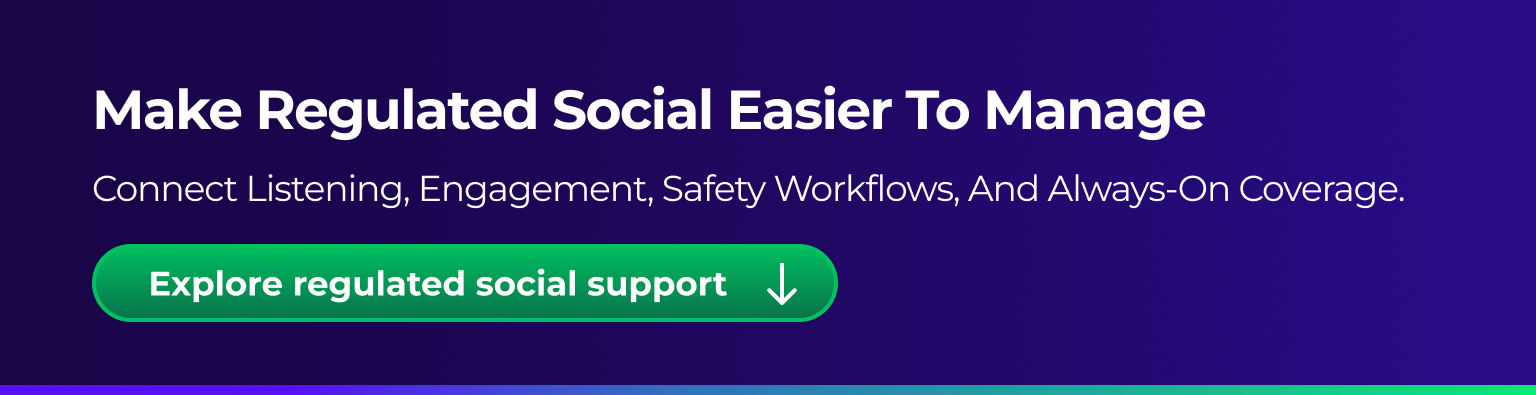
How pharma brands can build trust through social mediaTrust grows when your social presence reflects what patients and communities actually need. ICUC’s BEAT framework turns social intelligence into four forms of participation: Build trust, Engage communities, Address concerns, and Transform narratives.
Build trust: Use credible patient perspectives, advocacy relationships, transparent sourcing, and useful educational content to demonstrate that your organization understands the lived reality surrounding a condition. First-person perspectives can add context when they are handled with appropriate consent, disclosures, and review.
Engage communities: Respond to appropriate questions, acknowledge concerns, and guide people toward credible resources. Recurring questions can also reveal where educational material is unclear or where the patient journey contains friction.
Address concerns: Understand what is being said, why a narrative is gaining traction, who is participating, and whether intervention would clarify or amplify the issue. When a response is appropriate, use accurate, approved information and route medical or safety issues through established workflows.
Transform narratives: Make useful information about research, innovation, access, support, and positive outcomes easier to find without overstating what those stories prove.
BEAT works best when supported by an intelligence layer:
Social listening → patient journey mapping → actionable intelligence → engagement
That moves strategy from assumptions toward patient reality, emotional context, and more informed participation.
How to operationalize pharma social media safely at scale
A strong strategy must work across brand, MLR, pharmacovigilance, community teams, regions, and external partners without creating gaps in accountability or coverage.
Your operating model should address:
Roles and responsibilities: Define ownership across brand, medical, legal, regulatory, safety, community, and agency teams.
Trained human review: Ensure relevant reviewers understand safety triggers, brand requirements, and escalation protocols.
Documented escalation: Establish routing paths, contacts, severity levels, and SLAs.
QA and reconciliation: Confirm that relevant activity is processed accurately across systems.
Always-on coverage: Account for nights, weekends, congresses, launches, and crises.
Multilingual operations: Apply consistent safety and quality standards while retaining cultural nuance.
Technology integration: Connect listening, social management, compliance, CRM, and case-management systems where appropriate.
Crisis and misinformation response: Predefine thresholds for issues requiring cross-functional attention.
Third-party governance: Clarify what external partners handle and how information moves between organizations.
Compliance can enable participation when teams agree in advance on how appropriate engagement should happen.
Planning and publishing with confidence
Create a publishing model that gives your teams enough structure to move consistently without forcing every post through an entirely new process. Shared themes, defined cadences, reusable approved assets, and planned localization windows can reduce unnecessary review cycles while giving regional teams enough time to adapt content appropriately.
Build flexibility into that model for moments when social activity accelerates. Congresses, launches, breaking news, and emerging patient conversations may require tighter publishing cadences, faster approvals, and closer coordination between brand, MLR, community, and safety teams.
The strategic question is whether your content operation can scale with demand without sacrificing review quality, regional relevance, or responsiveness once content goes live.
Align internal teams and advocates
Scaling pharma social also means making sure critical knowledge does not live with only a few people. Role-based playbooks, current SOPs, approved response resources, and regular training help teams make consistent decisions without relying on a handful of experienced people to interpret every situation.
Give brand, MLR, safety, community, and regional teams a shared understanding of what they own and when another function needs to step in. HCP contributors and spokespeople may also need role-specific disclosure guidance, comment protocols, and training.
Apply the same approach to planned listening so reviewers can recognize relevant safety content in everyday social language and route it appropriately. Similar principles apply to social media marketing for healthcare: communications and operational safeguards work best when they are designed together.
How to measure pharma social media performance
Visible engagement cannot capture the full impact of pharma social activity. The hidden-majority effect makes this especially important. A patient may watch an educational video, read a thread, search for more information, or discuss it privately without ever liking or commenting publicly.
Combine platform analytics with listening and qualitative intelligence.
Objective | Useful metrics/signals |
Awareness | Reach, impressions, completion |
Engagement | Comments, shares, saves, conversation quality |
Patient understanding | Recurring questions, information needs, content behavior |
Reputation | Sentiment, narrative themes, misinformation |
Community care | Response time, resolution, escalation |
Safety | Safety-relevant content identified/routed, workflow performance |
Business impact | Relevant conversions, actions, or downstream outcomes |
Use those metrics to guide ongoing testing. Compare messages, formats, distribution approaches, and timing to understand what improves audience understanding and program performance without adding unnecessary compliance complexity. Feed those findings into future content strategy, governance, and resource decisions.
Monthly executive reporting can surface changes in reputation, audience needs, engagement quality, and operational performance, while deeper quarterly reviews can identify patterns requiring input from marketing, medical, legal, or safety leadership. The reporting should help leaders decide where to invest, what content to prioritize, which processes need attention, and which emerging risks deserve a closer look.
What should pharma brands look for in a social media partner?
A pharma social media partner may participate in publishing, community management, listening, moderation, or safety escalation. The capabilities you expect internally should also shape how you evaluate an external provider. Look beyond a generic service list and assess how the work is actually governed and executed.
Ask about:
Regulated-industry experience: Does the team understand pharmaceutical social requirements?
Safety-content recognition: Can reviewers identify potential AEs, ADRs, off-label discussions, product complaints, and other defined triggers?
Training: How are reviewers trained and reassessed?
Escalation: Are pathways, SLAs, contacts, and handoffs documented?
QA and reconciliation: How does the partner verify that relevant content was reviewed, documented, and routed correctly?
Monitoring cadence: Does coverage align with program and safety requirements?
Always-on support: Can the team cover nights, weekends, high-volume events, and global markets?
Multilingual expertise: Can reviewers interpret language and cultural context accurately across your priority markets?
Governance: Are responsibilities between the MAH and provider clearly defined?
Technology integration: Can the team work within your existing social and safety systems?
These questions become especially important when a service provider participates in activities that may identify safety information. Your partner should strengthen the connection between social insight and regulated execution rather than introduce another handoff where important context can disappear.
Build a pharma social strategy for intelligence and action with ICUC
Effective pharma social media marketing requires both intelligence and action. Social intelligence can help you identify patient needs, misinformation, reputation shifts, and emerging narratives, but responding to those signals in a regulated environment can put significant pressure on internal teams.
At ICUC, we understand how complex it can be to manage patient, caregiver, and HCP conversations while also keeping up with adverse event reporting, MLR requirements, privacy, documentation, and regional compliance.
Our pharma specialists monitor and manage those conversations around the clock, identifying potential risks and routing them through the right workflows so responses stay thoughtful, timely, and aligned with your brand and compliance requirements.
24/7 social monitoring and community management: Keep coverage consistent across channels, regions, and time zones.
Pharmacovigilance support: Identify and escalate potential adverse events through trained review and documented workflows.
Multilingual regulated engagement: Support patient and HCP communities across markets while accounting for local language and context.
QA and audit-ready processes: Strengthen consistency, documentation, and accountability across social operations.
We’re here to support your team from listening and community management through safety escalation and QA, so you’re not left managing every comment, signal, market, and handoff on your own. ICUC’s pharma social media services help you stay active across social channels while protecting patients, supporting compliance, strengthening brand trust, and turning social conversations into useful intelligence.
To assess where your current social listening, community, or pharmacovigilance workflows may need more support, book a meeting with ICUC.
FAQ: Pharma social media marketing
What are the FDA guidelines for pharma social media?
There is no single FDA social media rule covering every pharmaceutical activity. Requirements can depend on promotional claims, risk information, safety reporting, platform type, and how your company participates. Teams looking for FDA social media guidelines should start with current primary resources and involve legal, regulatory, medical, and pharmacovigilance teams when establishing policies.
FDA’s March 2026 E2D(R1) guidance specifically provides updated direction on digital platforms, planned social listening, safety reporting, and case management.
What is ICH E2D(R1)?
ICH E2D(R1) is updated international guidance covering the management and reporting of post-approval individual case safety reports. FDA issued the final guidance in March 2026, clarifying newer sources of safety information such as digital platforms and social media.
How does E2D(R1) affect social listening?
E2D(R1) identifies planned social or digital listening as an example of an ODCS when an MAH intentionally monitors and analyzes social communications. Relevant activities should define objectives, data sources, dataset scope, review methods, and processes for managing safety information identified during review.
How should pharma brands monitor social media for adverse events?
Define which activity requires review, who performs it, what reviewers should recognize, how relevant content is documented, and how quickly it must be escalated. Build the workflow with your pharmacovigilance, medical, legal, and regulatory teams so it reflects applicable reporting requirements.
Is a pharmaceutical company still responsible when social listening is outsourced?
Yes. E2D(R1) states that the MAH remains ultimately responsible for meeting applicable reporting timelines when third parties support relevant activities. Agreements should clearly define safety-information exchange, timelines, and responsibilities.
How can pharma brands participate on social media while remaining compliant?
Build compliance into the operating model before engagement begins. Establish MLR processes, approved claims and disclosures, privacy controls, market-specific requirements, reviewer training, escalation workflows, response guidance, and recordkeeping so teams know when and how they can participate.
About the Author

Nicole van Zanten
As Chief Growth Officer at ICUC, Nicole leads global growth across marketing, client success, and business development. With over 15 years of leadership in social media, content strategy, and digital transformation, she brings a unique mix of creative vision and operational rigor to building high-performance teams and sustainable revenue growth.